Friday, June 5, 2015

Spring Flowers


This is the last month of spring! Spring is a great time to see the Netherlands and experience everything in bloom. Here are some photos from spring, starting from the first crocuses at the end of winter...


...and then the daffodils and narcissus.


From there it's a progressions of bulbs, shrubs, and trees in bright colors and sweet aromas.


 Don't forget to look up!


Finally, the roses make their appearance.


I seem to have forgotten something...


Can't leave out tulips!

Thursday, May 28, 2015

Reading Window


Another graphite sketch. This one is based on a photo taken by H. Armstrong Roberts in 1930.

Friday, May 22, 2015

Window Light

I bought some new graphite pencils from Prismacolor. They are called Ebony Sketching Pencils and are advertised as jet black and extra smooth. I made this sketch to try them out. They do seem pretty smooth, and I'm satisfied with the result.

This sketch is based on a 1910 photo taken at a Paris design house called Callot Soeurs.

Friday, May 15, 2015

Hortus botanicus

Leiden, Netherlands


The Hortus botanicaus in Leiden is celebrating 425 years. Connected to the University of Leiden, the botanical gardens have spent the last four and a quarter centuries building and caring for an impressive collection of plants from around the world. During the Dutch golden age, many specimens collected by sailing expeditions as they explored the far corners of the globe ended up here. This included the exotic tulip bulb. Now, the gardens play a role in cultivating some of the rare and endangered species that are disappearing in the wild.

The outdoor gardens can be explored by walking the many winding paths. Follow the "systematic garden" to learn about the relationships between particular plants, or take in the colors and fragrances found in the rose garden. The Japanese Garden offers a peaceful bench where you can enjoy a beautiful collection of trees and shrubs from Japan. Continue on to follow a small woodland stream lined with wildflowers.


As you stroll through the grounds, you will see a beautiful collection of trees that have been growing for 100-400 years.


Be sure to check out the greenhouses to find tropical plants and other heat-loving species.


There are over 6000 types of orchids being studied here, and the collection is still growing as newly discovered species are added.


Carnivorous plants grow in soil that is poor in nutrients, so they eat insects instead! These plants have developed various methods to attract their prey. Some use sticky droplets to ensnare unsuspecting flies.


Others catch insects in slippery pitchers. Once something slides in, there is no climbing out...


The Victoria amazonica is a giant water lily that grows in rivers feeding into the Amazon. Discovered in the 1850s, the university began cultivating it here shortly afterwards. The leaves are big enough to hold a small child. Each flower blooms for two days; the first day it is white with a fruity aroma to attract pollinating beetles, while the second day it is pink with no smell.


The Jade vine comes from the Phillipines. It relies on bats for pollination. It is considered to be a threatened species due to loss of habitat and pollinators, which is a shame because the large hanging bunches of jade green flowers are absolutely stunning.


There is also a collection of "prehistoric plants" scattered around, consisting of some of the oldest plant forms such as ginkgo, cycads, horsetails, and ferns.


Visiting the garden in spring or early summer is a special treat with the shear number of flowers blooming. While Keukenhof (near Lisse) is famous with the tourists who want to see carefully groomed tulip gardens, Hortus botanicus offers a more peaceful and intimate setting to discover an incredible variety of plants that range from beautiful to strange.


Hortus botanicus Leiden, Rapenburg 73, 2311 GJ Leiden
Open year round. Admission charged
Learn More: Website


Wednesday, May 6, 2015

The 4th and 5th of May

The 4th and 5th of May are Dodenherdenking (Remembrance Day) and Bevrijdingsdag (Liberation Day) here in the Netherlands. I thought it was past time for me to write an article about this, but the weather ended up being so stormy that I didn't go out after all so I don't have any photos from this year. Instead, I'll just tell you what it's all about with the promise to get some good pictures next year.

Observance of these two days began after World War II. Remembrance Day was set aside to remember all the victims of war, at first focusing on the Second World War but growing to encompass all victims in the subsequent decades. While various ceremonies take place around the country, the biggest one occurs in the evening in Amsterdam's Dam Square. A large crowd gathers around the square, and if you aren't there in person there's a good chance you are watching it on television.
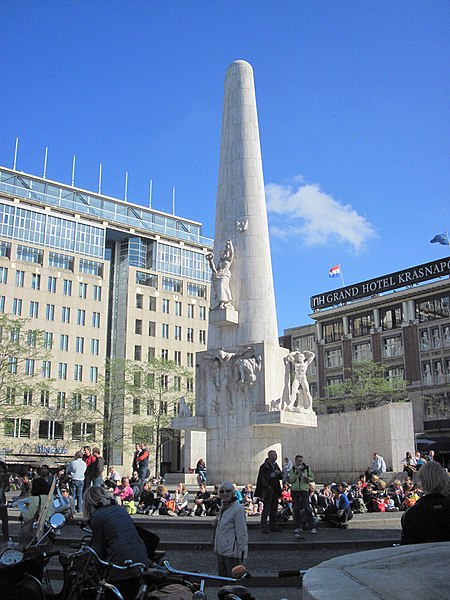
Dam Square on a normal day.
Photo: Wikipedia.org

The ceremony is centered around the National Monument, a towering white pillar that was constructed in the 1950s to remember WWII. Within the monument are urns filled with soil gathered from execution grounds in each of the Dutch provinces. It is here that the King and Queen start the ceremony by laying flowered wreaths. At 8 PM, Dam Square, along with the rest of the Netherlands, falls silent for 2 minutes. Even trains, planes, and other traffic are scheduled so their departures/arrivals do not interrupt these 2 minutes.

The moment of silence is broken by Wilhelmus, the Dutch national anthem. The ceremony moves forward with a student reading his or her poem written in honor of the event. More wreaths are laid by veterans, representatives of the armed forces, and finally government officials. Each wreath represents different groups of people who have been victims of war and violence, both soldiers and civilians. The last flowers are left by a long line of local school kids who file around the pillar.
Rotterdam 2013

Rotterdam 2013
After this solemn remembrance, the 5th of May is time to celebrate freedom! The Liberation flame is lit at midnight, and from this flame torches are lit and carried throughout the rest of the country. That day, people all over the Netherlands enjoy outdoor concerts in commemoration of Holland's liberation on May 5th, 1945 by Canadian and other Allied forces. Though there are events held each year, it is only an official holiday every 5 years. Large cities such as Rotterdam host huge festivals with popular musicians, while smaller communities organize their own musical performances, local history displays, and fireworks.


Thursday, April 30, 2015

A Ghost in Antwerp

This old pair of sunglasses were on their way to the trash when I swiped them for an art project. They reminded me of simple wire rimmed frames from the early 20th century (they're not really that old, so I didn't care if I messed them up!) I thought it would be neat if you could pick up a pair of old glasses and watch a recording of what had been seen through them. I considered inventing such a system, but worried it could get rather creepy so instead I decided to paint a semi-hypothetical 1900s scene to see through these not-quite-1900s glasses.

The right lens shows Antwerp Central Station, which is one of the most stunning train stations I've visited. It was finished in 1905 and the architecture features a dome on top. A clock framed by beautiful arched windows (which you can see in this photo from my Etsy shop) dominates the interior.

In the left lens is Hungarian operetta singer Sari Petrass as she would have looked if she had been on her way to an evening performance in the city before WWI. In reality, she didn't arrive in Antwerp until 1930, when the car she was riding in attempted to board a ferry and instead crashed into the river, where she drowned.

The painting is made with egg tempera, and each lens measures only 4.5cm (1.75") across.

Friday, April 10, 2015

Easter Paasstol

Last weekend was Easter, and this year my Dutchman and I tried to partake of more Dutch traditions than just enjoying the "Second Easter" Monday off (Second Easter being an additional holiday intended to give people the chance to visit other family who you didn't see on Easter Sunday). He decided to try his hand at Paasstol. This turned out to be a spiced raisin bread filled with almond paste. I helped him make the paste from scratch with fresh almonds and lemon rind. The raisins are sometimes soaked in rum, but not having any on hand we went with KahlĂșa instead (ok, not so traditional, but our own special twist). The result was, as the Dutch say, lekker! The bread is sweet with the raisins mixed in and has a light undertone of cinnamon. This is topped with a flaky crust and filled with a divine combination of buttery almond and lemon. It goes wonderfully with a hot cup of coffee.

Here's the loaf we made.
Are you salivating yet? If you're into baking check out this recipe on Stefan's Gourmet Blog. We didn't use this exact recipe, but it is pretty similar and looks just as tasty.